


The Resistor Color Code Calculator functions as a perfect tool for anyone who needs it, from beginners to professional engineers.
A detailed guide coupled with a calculator tool will enable you to rapidly determine the resistance value, tolerance, and temperature coefficient of any carbon-composition resistor regardless of its 4-band, 5-band, or 6-band configuration.
echo 'Welcome to resistorcolorcode.in, your trusted online destination to understand the resistor color code easily and accurately. This website is specially designed for students, electronics learners, technicians, and professionals who want a quick and reliable way to calculate resistor values.
The resistor color code system uses colored bands to represent resistance value, tolerance, and other important parameters. Reading these bands manually can be confusing, especially for beginners. That’s why we provide an easy-to-use Resistor Color Code Calculator that instantly converts color bands into resistance values.
At resistorcolorcode.in, you can calculate resistance for:
Our advanced resistance calculator for 5 band and 6 band resistors is ideal for precision resistors commonly used in electronic circuits, PCB repair, and professional projects.
Whether you are learning electronics, repairing a PCB, or working on a DIY project, our tool helps you understand the resistor color code quickly without confusion.
Our goal is to make electronics simple. With resistorcolorcode.in, you don’t need to memorize color charts. Just select the band colors, and the calculator will do the rest. This makes learning and working with the resistor color code faster, easier, and more practical.
'; ?>The electrical properties of resistors get marked with standardized colored bands through the resistor color code system.
The standardized band sequence provides immediate access to resistor characteristics, including ohm (Ω) resistance values, precision measurements, and thermal stability information.
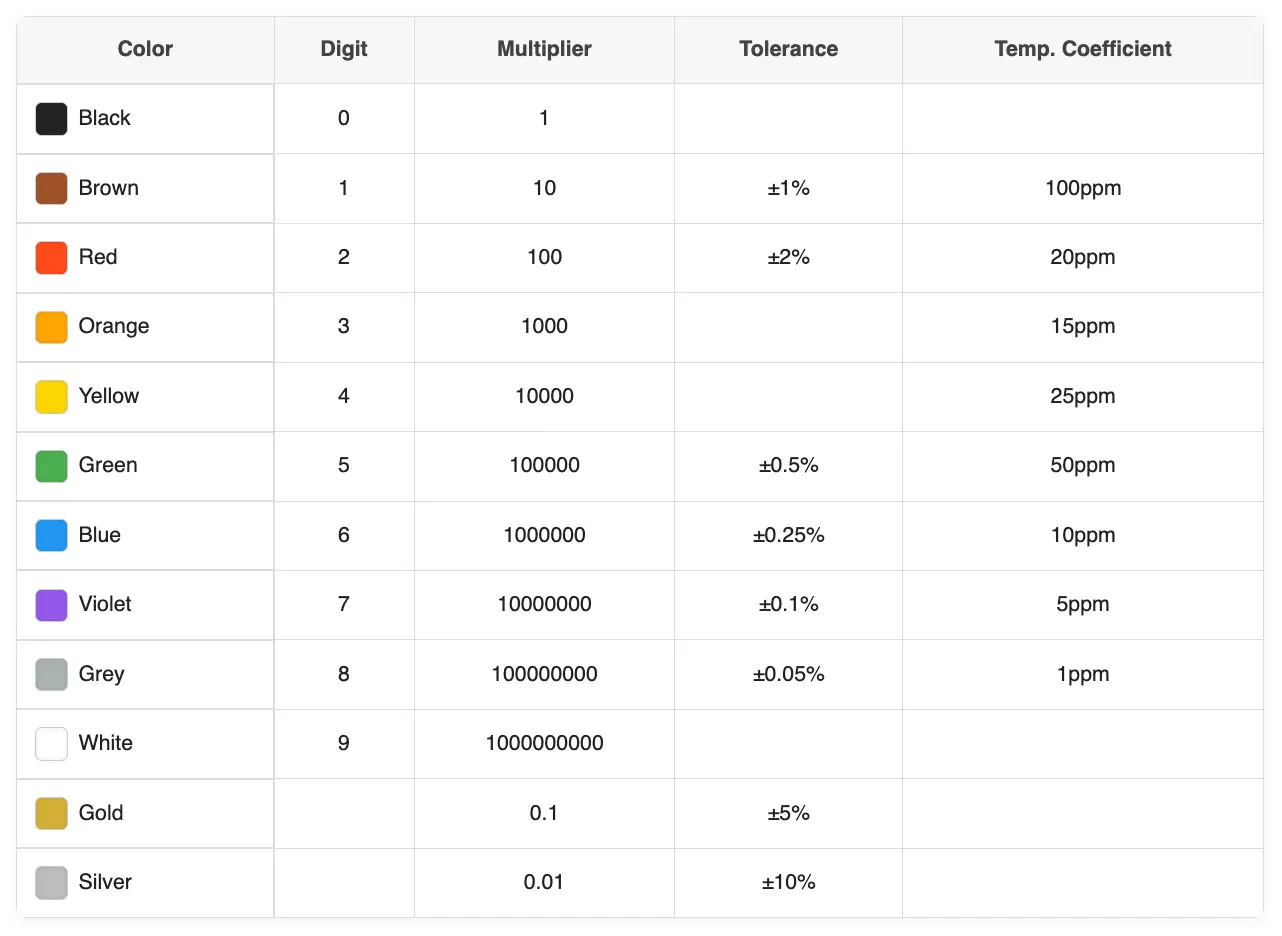
A standard resistor comes with either four, five, or six colored bands. The resistor features bands which function for particular purposes:
Reading resistor color bands can sometimes be confusing, especially for beginners. Follow these simple tips to read the bands correctly from left to right and get accurate results.
Select the color for each resistor band in the calculator to instantly show the resistance value, including:
This feature helps you match the resistor color bands with the digital result, reducing mistakes and avoiding guesswork.
The tolerance band is always the last band on the resistor and is usually separated from the other bands by a wider gap. Gold and silver colors are never used for significant digits, so when you see them, you can confidently identify them as the tolerance band.
In many resistors, the tolerance band is printed wider than the other bands-often about 1.5 to 2 times wider-making it easier to identify the correct reading direction.
For critical or precision applications, always refer to the manufacturer's datasheet. It provides the most accurate and reliable resistor specifications.
The most reliable way to confirm a resistor's actual value is by measuring it with a multimeter. This is especially useful for old, damaged, or faded resistors.
By following these guidelines and using our Resistor Color Code Calculator, you can confidently and accurately identify any resistor value, ensuring your electronic circuits are built correctly and perform as intended.
 Calculator
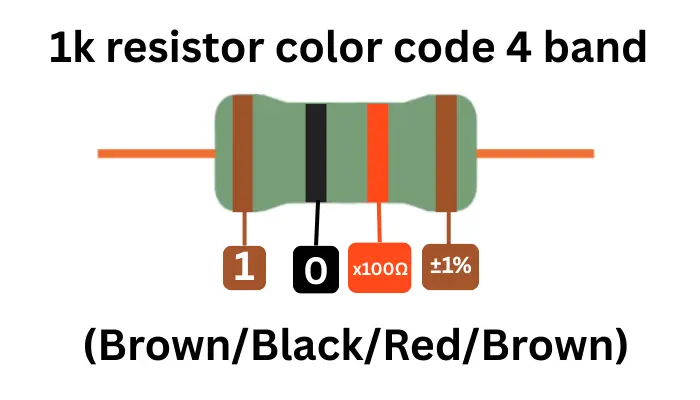
Brown → 1 (1st digit)
Black → 0 (2nd digit)
Red → ×100 (multiplier)
Gold → ±5 % (tolerance)
Final value: 1 kΩ ± 5 %
Calculator
Brown → 1 (1st digit)
Black → 0 (2nd digit)
Red → ×100 (multiplier)
Gold → ±5 % (tolerance)
Final value: 1 kΩ ± 5 %
The 1 kΩ (1000 Ω) 5-band resistor color code is:
Brown – Black – Black – Brown – Brown
.webp)
Final Value: 1 kΩ ± 5%
The 1 kΩ (1000 Ω) 6-band resistor color code (with Gold tolerance) is:
Brown – Black – Black – Brown – Gold – Brown
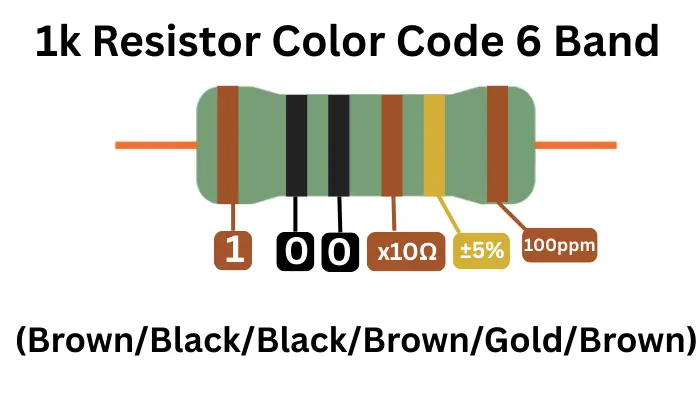
Final Value: 1 kΩ ± 5% (100 ppm/°C)
 Calculator
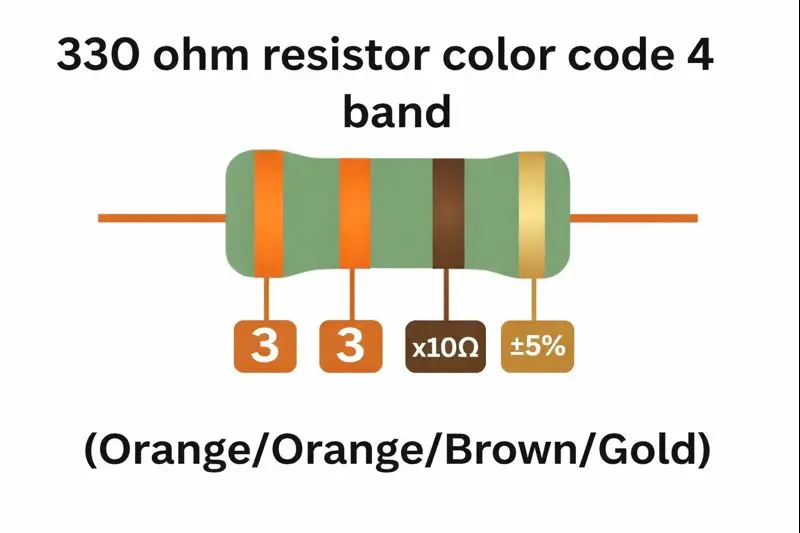
Orange → 3 (1st digit)
Orange → 3 (2nd digit)
Brown → ×10 (multiplier)
Gold → ±5 % (tolerance)
Final Value
Final value: 33 × 10 = 330 Ω ± 5 %
A 330 ohm resistor has two significant digits 3 and 3, represented by orange and orange color bands.
The multiplier brown (×10) increases the value to 330 ohms, and the gold band indicates ±5% tolerance.
= 330 Ω = Orange – Orange – Brown – Gold
Calculator
Orange → 3 (1st digit)
Orange → 3 (2nd digit)
Brown → ×10 (multiplier)
Gold → ±5 % (tolerance)
Final Value
Final value: 33 × 10 = 330 Ω ± 5 %
A 330 ohm resistor has two significant digits 3 and 3, represented by orange and orange color bands.
The multiplier brown (×10) increases the value to 330 ohms, and the gold band indicates ±5% tolerance.
= 330 Ω = Orange – Orange – Brown – Gold
Brown, Black, Orange, and Brown resistor value:
The Brown – Black – Orange – Brown resistor color code represents a 10 kΩ (10,000 Ω) resistor with a tolerance of ±1%.
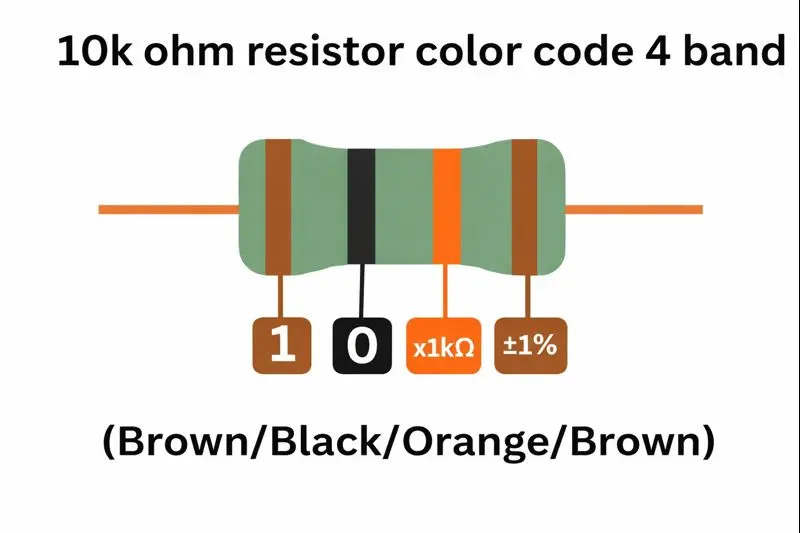
Final Value: 10,000 Ω ± 1% (10 kΩ ± 1%)
Brown, Black, Orange, and Brown resistor value = 10 kΩ
Red, Red, Brown, and Brown resistor value:
The Red – Red – Brown – Brown resistor color code represents a 220 Ω resistor with a tolerance of ±1%.
.webp)
Final Value: 220 Ω ± 1%
Red, Red, Brown, and Brown resistor value = 220 Ω
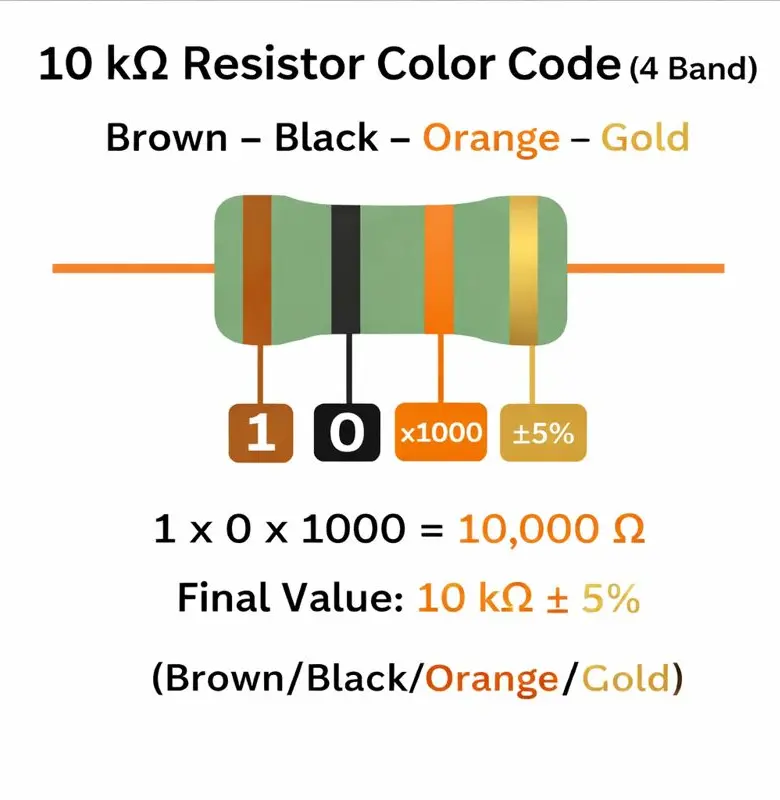
Final Value: 10 kΩ ± 5%
Brown Black Orange Gold resistor value = 10 kΩ
Got it! Using the same style, your 4.7 kΩ example would look like this: